The Hidden Liability Killing Your Revenue Engine
Every company understands financial debt.
Few understand Revenue Process Debt — even though it quietly compounds faster, spreads wider, and is far harder to unwind.
Revenue Process Debt occurs when your go-to-market system prioritizes speed over structure, growth over discipline, and short-term wins over long-term scalability.
At first, it looks like progress.
Then it becomes drag.
Eventually, it becomes revenue leakage disguised as complexity.
What Is Revenue Process Debt?
Revenue Process Debt is the accumulated cost of inefficient, inconsistent, or poorly designed revenue processes across your GTM engine.
It shows up as:
- Manual workarounds instead of automation
- Inconsistent sales stages and definitions
- CRM fields that no one trusts
- Forecasts built on judgment instead of data
- Handoffs that break between teams
- “Shadow processes” living in spreadsheets and Slack
Just like technical debt in engineering, it accrues when teams say:
“We’ll fix it later.”
But in RevOps…
Later rarely comes.
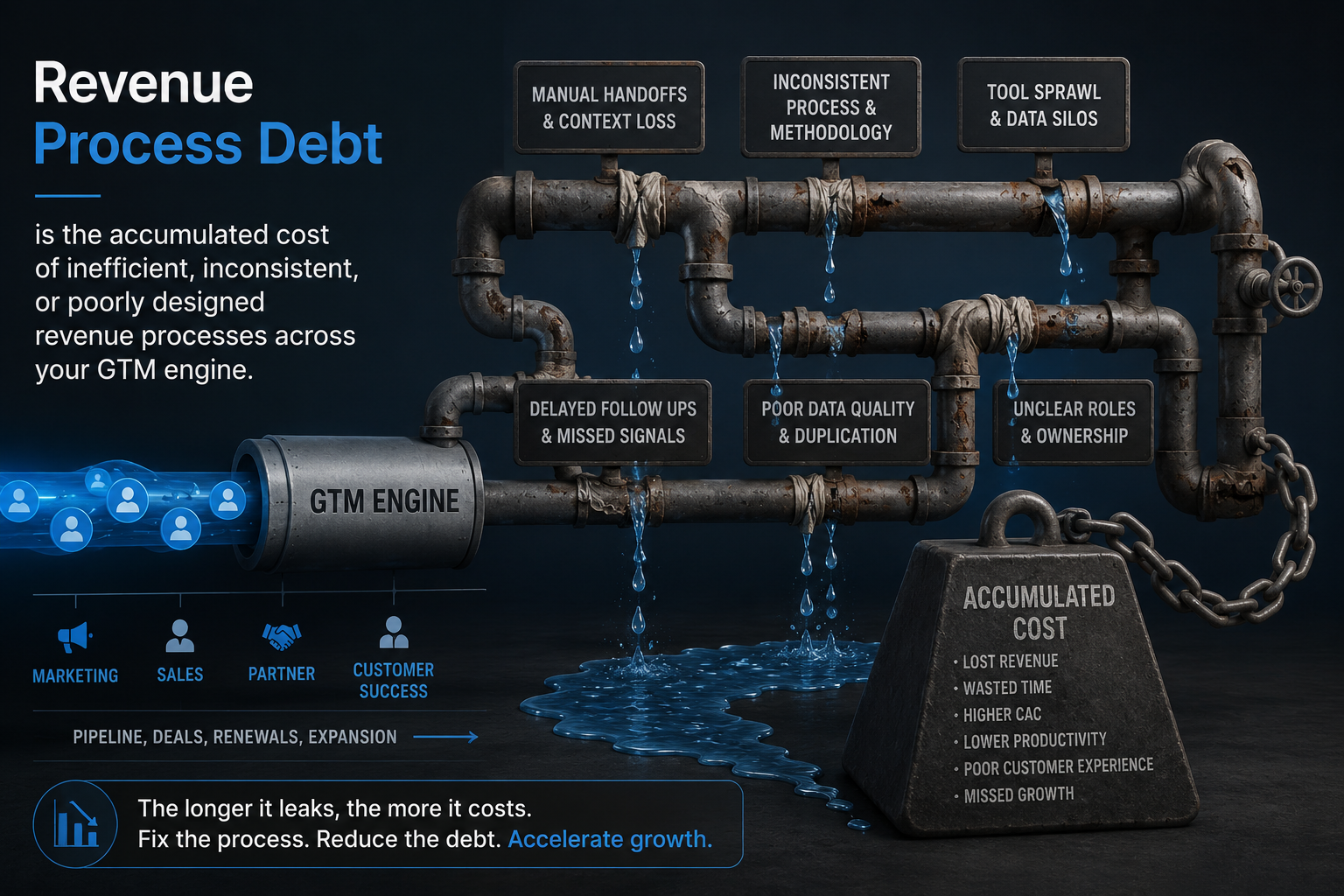
The Revenue Process Debt Snowball
Here’s the critical insight:
Revenue Process Debt doesn’t stay contained.
It compounds across the entire system.
“Revenue Process Debt”
Shortcut Taken → Process Break → Manual Workaround → Data Corruption →
Forecast Inaccuracy → Firefighting → More Shortcuts
This loop creates a dangerous dynamic:
- Speed decreases
- Costs increase
- Trust erodes
- Decision quality collapses
And yet…
Headcount often increases to compensate, masking the real issue.
Where Revenue Process Debt Comes From
Most organizations don’t choose to create debt.
They inherit it through growth.
- Hypergrowth Without Process Design
- Sales scale faster than infrastructure
- New hires create their own workflows
- Tribal knowledge replaces standardized playbooks
-
Tool Sprawl
- CRM + enrichment + engagement + forecasting tools
- No unified data model
- Conflicting sources of truth
- Misaligned Incentives
- Sales optimized for closing, not data quality
- Marketing optimized for volume, not conversion
- RevOps is stuck reconciling both
-
Constant Change Without Governance
- New stages, fields, and rules added ad hoc
- No version control for process changes
- No ownership of system integrity
The Symptoms (That Leaders Misdiagnose)
Revenue Process Debt rarely gets called out directly.
Instead, it shows up as:
“Pipeline Problem”
- Low conversion rates
- Stalled deals
“Forecast Problem”
- Missed numbers
- Last-minute surprises
“Productivity Problem”
- Reps spending more time on admin than selling
“Hiring Problem”
- “We just need more reps.”
But these are surface-level symptoms.
The root cause is almost always:
Your revenue process is no longer trustworthy.
The Cost of Revenue Process Debt
Let’s quantify what’s actually happening.
-
Time Tax
- Reps spend 20–40% of their time on non-selling activities
- Managers spend hours reconciling the pipeline
-
Data Decay
- CRM becomes a lagging indicator instead of a system of truth
- Reporting becomes interpretive instead of factual
-
Forecast Volatility
- Confidence drops
- Executive decisions become reactive
-
Revenue Leakage
- Deals fall through cracks
- Follow-ups don’t happen
- Expansion opportunities missed
A Simple Diagnostic: Your Debt Level
Ask these five questions:
- Do multiple teams define pipeline stages differently?
- Can you trust your forecast without manual overrides?
- Are reps maintaining “parallel systems” outside the CRM?
- Do handoffs (SDR → AE → CS) consistently break?
- Does RevOps spend more time fixing data than improving strategy?
If you answered “yes” to 3 or more:
You don’t have a tooling problem.
You have a Revenue Process Debt problem.
How to Pay Off Revenue Process Debt
Paying down this debt is not a cleanup project.
It’s an operational transformation.
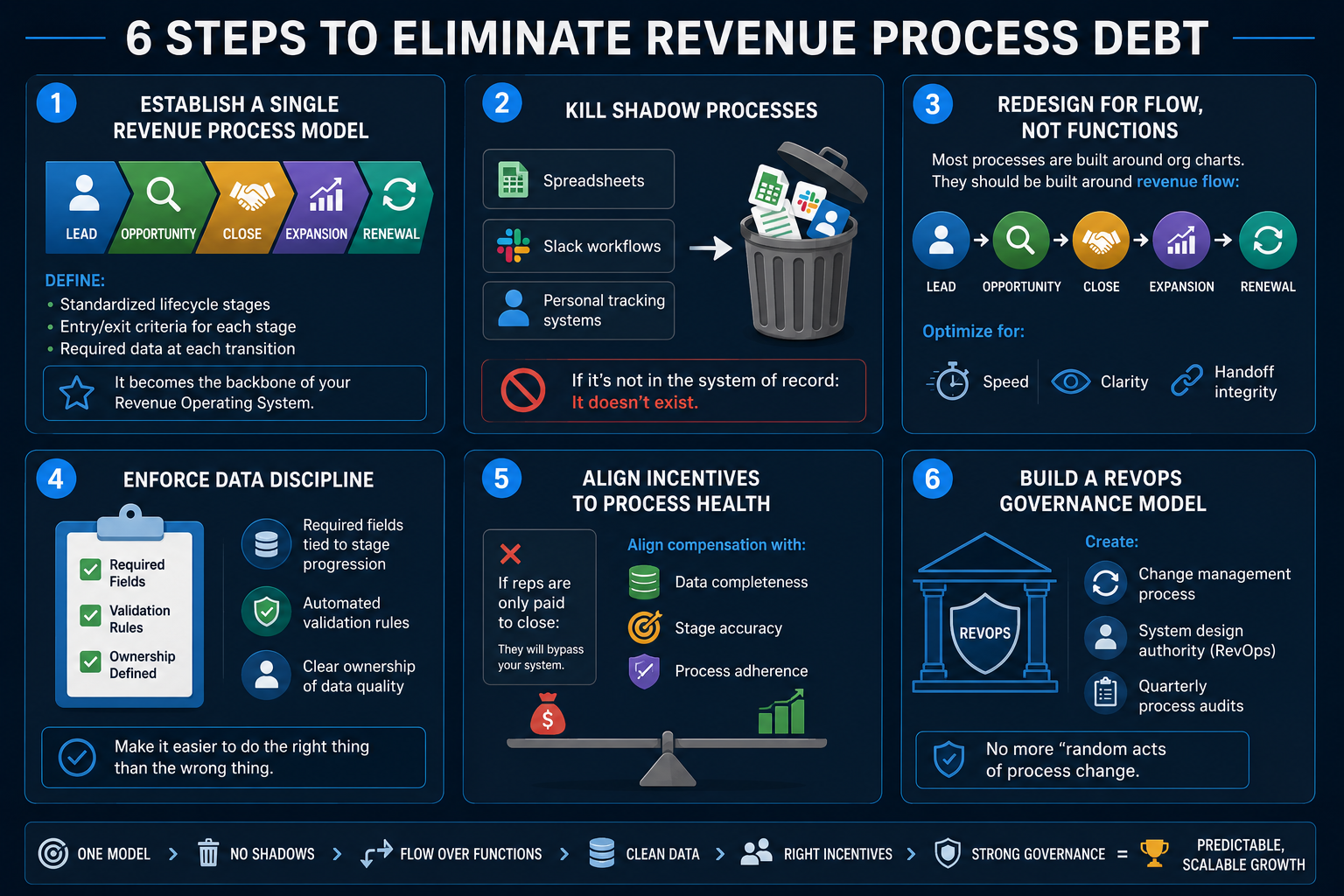
Step 1: Establish a Single Revenue Process Model
Define:
- Standardized lifecycle stages
- Entry/exit criteria for each stage
- Required data at each transition
It becomes the backbone of your Revenue Operating System.
Step 2: Kill Shadow Processes
Audit:
- Spreadsheets
- Slack workflows
- Personal tracking systems
If it’s not in the system of record:
It doesn’t exist.
Step 3: Redesign for Flow, Not Functions
Most processes are built around org charts.
They should be built around revenue flow:
Lead → Opportunity → Close → Expansion → Renewal
Optimize for:
- Speed
- Clarity
- Handoff integrity
Step 4: Enforce Data Discipline
Introduce:
- Required fields tied to stage progression
- Automated validation rules
- Clear ownership of data quality
Make it easier to do the right thing than the wrong thing.
Step 5: Align Incentives to Process Health
If reps are only paid to close:
They will bypass your system.
Align compensation with:
- Data completeness
- Stage accuracy
- Process adherence
Step 6: Build a RevOps Governance Model
Create:
- Change management process
- System design authority (RevOps)
- Quarterly process audits
No more “random acts of process change.”
The Payoff: From Drag to Efficiency Engine
When Revenue Process Debt is reduced, the impact is immediate:
Before
- Forecast = guesswork
- Pipeline = inflated
- Productivity = low
- Growth = expensive
After
- Forecast = reliable
- Pipeline = real
- Productivity = high
- Growth = efficient
This is where you unlock:
Revenue Efficiency at scale
The Strategic Insight Most Leaders Miss
Revenue Process Debt is not a RevOps issue.
It is a leadership issue.
Because every shortcut that creates debt was once approved, tolerated, or ignored.
The companies that win are not the ones with the best tools.
They are the ones with the cleanest, most disciplined revenue systems.
Final Thought
You can’t scale chaos.
You can only scale what you standardize, measure, and enforce.
Revenue Process Debt is the tax you pay for avoiding that discipline.
The question is:
Are you going to keep paying interest…
Or finally pay down the principal?