Why Most RevOps Transformations Fail—and How to Avoid the Pitfalls That Quietly Kill Growth
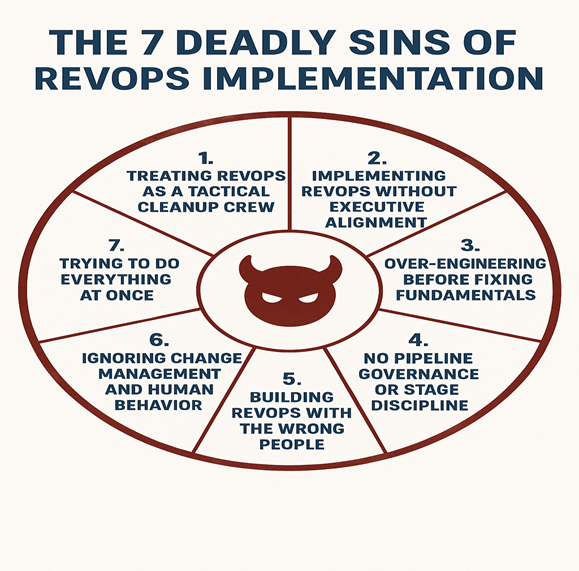
Revenue Operations is no longer a niche function. It’s the backbone of modern GTM execution—the operating system that connects your data, systems, processes, and customer journey end to end.
And yet… RevOps implementations fail far more often than they succeed.
Not because companies don’t believe in it. Not because they lack tools. But because they unknowingly commit the same “deadly sins” over and over again.
If you’re building your first RevOps team, upgrading your GTM engine, or attempting a transformation that sticks, this guide is your warning label—and your blueprint.
Sin #1 — Treating RevOps as a Tactical Cleanup Crew
“Just fix Salesforce… and marketing attribution… and also build dashboards.”
The #1 reason RevOps fails is simple:
It’s positioned as a reactive support desk rather than a strategic operating function.
Leaders expect magic. But they staff for maintenance.
When RevOps is buried under:
- CRM admin work
- One-off sales requests
- Random reporting
- Lead routing emergencies
- “Could you just build a dashboard?”
…it becomes impossible to drive systemic improvement.
The Fix:
Position RevOps as a strategic lever:
- Define clear ownership over pipeline health, forecasting accuracy, SLA compliance, GTM architecture, and revenue insights.
- Establish an intake process to prioritize work based on business impact.
- Build a roadmap—not a queue.
RevOps succeeds only when it operates like Revenue Engineering, not Revenue IT Support.
Sin #2 — Implementing RevOps Without Executive Alignment
Everyone wants efficiency—until they must change how they work.
RevOps touches every GTM team. That means misalignment at the top instantly cripples progress.
Common patterns:
- CRO wants speed
- CMO wants volume
- The CEO wants predictability
- CS wants renewals
- Finance wants accuracy
Who wins? Nobody.
Because RevOps is caught in political crossfire with no mandate.
The Fix:
You need a cross-functional charter, signed by all GTM executives, that clarifies:
- What RevOps owns
- What it influences
- What success means
- What it will NOT do
If leadership isn’t aligned, RevOps becomes a tug-of-war rope rather than a business engine.
Sin #3 — Over-Engineering Before Fixing Fundamentals
You don’t need AI routing workflows when you can’t even trust your lead stages.
Companies love buying tech before fixing their business logic.
Examples:
- Implementing complex scoring when the basic qualification is broken
- Setting up forecasting AI when reps aren’t entering data
- Automating processes built on faulty definitions
- Buying a CDP when CRM hygiene is a disaster
Technology amplifies your process—for better or worse.
If your process is broken, automation speeds up the chaos.
The Fix:
Follow the hierarchy of RevOps readiness:
- Definitions (What does SQL mean? What is “Stage 3”?)
- Processes (How do we qualify? How do deals progress?)
- Data Hygiene (Are we capturing the correct data?)
- Enablement (Do people actually follow the process?)
- Automation (Can we now automate the stable parts?)
- Optimization + AI (Now we get fancy)
Build the foundation before the fountain.
Sin #4 — No Pipeline Governance or Stage Discipline
You cannot optimize what you cannot standardize.
Lots of RevOps teams spend time making dashboards look pretty…
…but the underlying pipeline is a landfill.
Symptoms include:
- Deals with no next step
- Stages used inconsistently across reps
- Sandbagging late in the quarter
- “Fake” pipe created to look healthy
- Forecasting based on rep gut-feel, not reality
This kills forecasting accuracy, marketing ROI, headcount planning, and executive trust.
The Fix:
Implement Pipeline Governance:
- Enforce stage entry/exit criteria
- Require next steps + close plans
- Automate hygiene checks
- Run weekly pipeline councils
- Produce pipe quality reports, not just quantity reports
Healthy pipeline → scalable revenue.
Sin #5 — Building RevOps With the Wrong People
Hiring a CRM admin and calling it a RevOps function is a recipe for failure.
Companies often under-hire or hire the wrong roles:
- They hire a Salesforce admin instead of a RevOps strategist
- They hire a data analyst who can’t run GTM processes
- They hire an enablement person who can’t architect systems
- They hire a “generalist” expected to do five jobs
RevOps needs three distinct skills:
- Systems architecture
- Business process design
- Analytical + strategic insight
Finding all three in one person is rare.
Expecting it is delusional.
The Fix:
Build a “Core RevOps Trio”:
- RevOps Strategist
Owns GTM architecture, forecasting, definitions, and planning. - RevOps Systems Architect
Owns the CRM, automation, workflow design, and integrations. - RevOps Analyst
Owns reporting, insights, modeling, and segmentation.
Then expand as needed:
- Enablement
- CS Ops
- Marketing Ops
- Deal Desk
- Data Engineering
This is how you scale responsibly.
Sin #6 — Ignoring Change Management and Human Behavior
RevOps is 20% systems, 80% habits.
You can redesign the entire funnel.
You can rebuild Salesforce.
You can automate workflows.
You can produce dashboards with laser-sharp accuracy.
None of it matters if people don’t adopt it.
Common failures:
- Reps ignoring new fields
- Managers are not coaching on the new process
- Leadership bypassing rules
- CS not entering renewal dates
- Marketing is not tagging sources properly
The Fix:
Treat RevOps changes like product launches:
- Provide training
- Share “Why this matters.”
- Share before/after examples
- Give managers talking points
- Follow a 30-60-90 adoption plan
- Measure compliance and coach around it
RevOps is change management at scale.
Sin #7 — Trying to Do Everything at Once
RevOps is a journey. Not a sprint. Not a single project. Not one hire.
Companies drown RevOps in competing priorities:
- Fix lead routing
- Rebuild scoring
- Implement new CPQ
- Redesign the SDR process
- Migrate CRM environments
- Rebuild forecasting
- Add dashboards
- Improve data governance
- Introduce AI workflows
…and all in a single quarter.
This is how burnout happens.
This is how quality drops.
This is how “RevOps doesn’t work here” becomes the narrative.
The Fix:
Create a RevOps Transformation Roadmap:
- Quarter 1: Clean the foundation
- Quarter 2: Build scalable processes
- Quarter 3: Automate workflows
- Quarter 4: Implement advanced analytics + AI
Order tasks by:
- Impact
- Effort
- Risk
- Dependencies
Great RevOps isn’t explosive.
It’s sequential and compounding.
The Moral of the Story: RevOps Isn’t a Role—It’s an Operating System
Teams fail when they think RevOps is:
❌ A department
❌ A Salesforce admin
❌ A reporting person
❌ A cleanup crew
❌ A project
Teams succeed when they see RevOps as:
✅ A business engine
✅ A strategic layer
✅ A system of orchestration
✅ A governance function
✅ The connective tissue of the entire GTM
Getting RevOps right unlocks:
- Predictable revenue
- Lower CAC
- Higher win rates
- Scalable processes
- Faster onboarding
- Better customer experience
- Growth that compounds
Getting it wrong locks you in the cycle of fire drills, reactivity, and missed targets.
Leave a Reply