Introduction: The Strategic Rebirth of Revenue Leadership
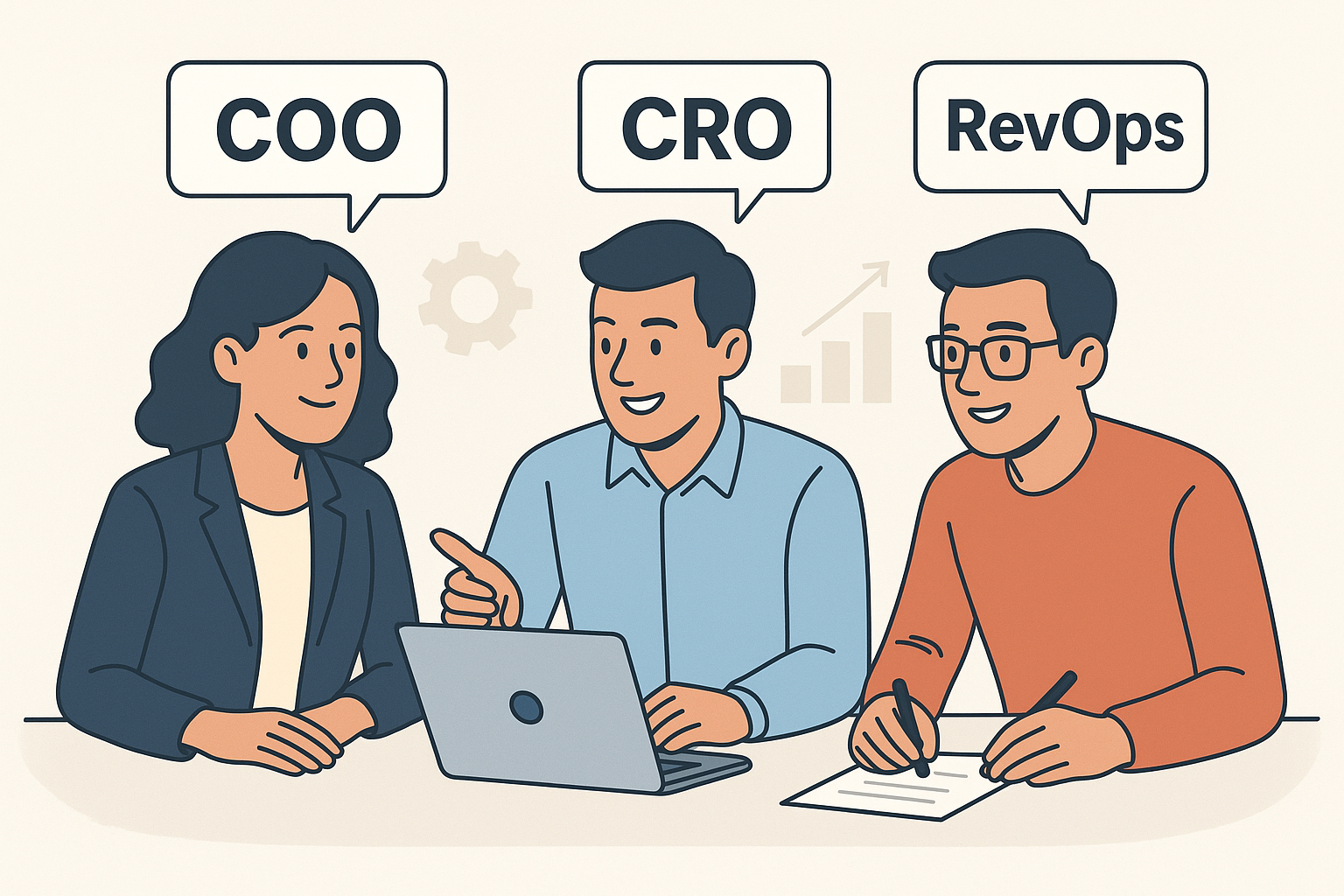
Revenue Operations (RevOps) has evolved from a behind-the-scenes function to a central driver of growth. In this new landscape, the Chief Operating Officer (COO) and Chief Revenue Officer (CRO) play pivotal, complementary roles. Together, they align strategy, process, and performance across the go-to-market (GTM) engine — ensuring marketing, sales, and customer success function as a unified system rather than isolated silos.
The modern COO and CRO are no longer limited to operational oversight or sales performance. They’re the architects of scale, responsible for building the connective tissue — data, systems, and processes — that drive predictable, profitable growth.
-
Understanding the RevOps Framework
RevOps aligns people, process, technology, and data across the GTM ecosystem. Instead of viewing sales, marketing, and customer success as separate entities, RevOps connects them through a shared operational foundation.
Core Objectives of RevOps:
- Drive visibility across the whole revenue funnel
- Improve efficiency through process standardization
- Leverage data for predictive insights and decision-making
- Enable cross-functional accountability around shared KPIs
This model creates a single source of truth for revenue performance—a structure that both the COO and CRO depend on to guide growth strategies and operational excellence.
-
The COO’s Role: Architect of Scalable Systems
The Chief Operating Officer is the operational strategist behind the scenes — ensuring the organization has the infrastructure, processes, and cross-functional alignment needed for growth.
Key Contributions to RevOps:
- Process Design and Efficiency
- The COO standardizes workflows across GTM teams to eliminate redundancy and friction.
- Example: Harmonizing lead handoff processes between marketing and sales to reduce lead leakage.
- Operational Governance
- Establishes frameworks for decision-making, goal-setting, and performance reviews.
- Implements OKRs or KPIs that map RevOps objectives to company-level growth outcomes.
- Data and Technology Infrastructure
- Partners with RevOps leaders to integrate tools like Salesforce, HubSpot, or Gong.
- Ensures the tech stack scales with growth and provides reliable data visibility.
- Resource Allocation and Budget Optimization
- Aligns financial planning with revenue efficiency metrics.
- Ensures GTM investments (people, tools, and programs) deliver measurable ROI.
COO in Action Example
A COO might identify that sales reps spend 25% of their time on administrative work. By partnering with RevOps to automate data entry, streamline reporting, and integrate CRM systems, the COO drives operational leverage — freeing reps to focus on revenue generation.
-
The CRO’s Role: Driver of Revenue Predictability
While the COO ensures the machine runs efficiently, the Chief Revenue Officer ensures it runs profitably and predictably.
Key Contributions to RevOps:
- GTM Alignment and Execution
- The CRO brings marketing, sales, and customer success into one revenue motion.
- Works with RevOps to align incentives, define ideal customer profiles (ICPs), and design efficient funnel strategies.
- Forecast Accuracy and Pipeline Health
- Uses RevOps insights to manage forecasting rigor, deal velocity, and conversion rates.
- Builds trust with the executive team and board by ensuring the revenue forecast is data-backed, not gut-based.
- Performance Optimization
- Identifies friction points in the buyer journey using RevOps analytics.
- Example: Improving demo-to-close rates through better lead scoring and enablement.
- GTM Experimentation
- Collaborates with RevOps to test new pricing, packaging, or sales motions (e.g., PLG or ABM).
- Uses RevOps data to assess impact and scale what works.
CRO in Action Example
A CRO might use RevOps dashboards to discover that enterprise leads have higher churn risk when onboarding is delayed by more than 14 days. Partnering with RevOps and Customer Success, they implement automation to accelerate onboarding and improve retention — protecting recurring revenue.
-
COO + CRO: The Power Partnership Behind RevOps
The most successful organizations don’t silo operations and revenue; they synchronize them. The partnership between the COO and CRO is where strategy meets execution.
| Area | COO Focus | CRO Focus | Shared Outcome | |
| Strategy Alignment | Business scalability | GTM growth strategy | Unified roadmap | |
| Data & Systems | Infrastructure integrity | Revenue insights | Single source of truth | |
| Execution | Operational excellence | Sales & CS performance | GTM efficiency | |
| Forecasting | Operational readiness | Predictable revenue | Reliable forecasting | |
| Customer Lifecycle | Process consistency | Retention & expansion | LTV maximization | |
This alignment ensures that every GTM motion — from demand generation to renewals — is efficient, measurable, and repeatable.
-
How RevOps Enables Growth and Scale
RevOps turns data into a competitive advantage by allowing leadership to see, understand, and act on revenue performance in real time.
Key Scaling Benefits:
- Predictability: Forecast accuracy improves as data silos are eliminated.
- Efficiency: Automation and standardization reduce cycle times.
- Accountability: Shared KPIs across teams promote transparency.
- Agility: Faster insights allow for quicker pivots in GTM strategy.
- Profitability: Better visibility into acquisition costs and LTV enables more intelligent investment decisions.
When the COO and CRO work in tandem with a mature RevOps function, they create a GTM engine that scales—not by adding headcount, but by amplifying performance through systems thinking.
-
Building the RevOps Leadership Flywheel
The RevOps function serves as the connective force between the COO’s operational governance and the CRO’s revenue ownership.
The Leadership Flywheel:
- COO: Defines systems and process efficiency.
- RevOps: Centralizes data and operational insight.
- CRO: Leverages insights to drive growth.
- Feedback Loop: Performance data informs strategic refinement.
Over time, this creates a self-optimizing growth model—a RevOps-driven organization that scales predictably and profitably.
-
Final Thoughts: RevOps as the New Executive Operating System
In today’s complex GTM landscape, RevOps isn’t just an operations discipline — it’s the operating system of growth. When aligned around RevOps principles, the COO and CRO transform from functional leaders into strategic co-pilots of the revenue engine.
Their shared success is measured not by siloed performance metrics but by how efficiently the entire GTM system scales.
RevOps gives them the levers — data, process, and visibility — to pull together.
Leave a Reply