In today’s GTM organizations, few topics spark more debate than where Marketing Operations (MOPs) ends and Revenue Operations (RevOps) begins. Both functions aim to drive efficiency, alignment, and growth—but without clear boundaries, overlap can cause friction, wasted resources, and confusion across teams.
The reality? MOPs and RevOps shouldn’t operate in silos, but they also can’t be redundant. The key is drawing the right line: defining roles, responsibilities, and processes so that campaign data flows seamlessly to sales—and everyone works toward the same revenue goals.
The Role of Marketing Ops
Marketing Operations ensures that campaigns run smoothly, tools integrate correctly, and data is clean for decision-making. Core responsibilities often include:
- Campaign Enablement: Setting up lead scoring, routing, and campaign tracking in MAPs (e.g., Marketo, HubSpot, Pardot).
- Data Hygiene & Enrichment: Maintaining marketing databases, contact/account enrichment, and segmentation.
- Attribution & Reporting: Measuring campaign performance, ROI, and marketing’s influence on pipeline.
- Process Optimization: Ensuring demand gen teams can scale campaigns efficiently.
In short, MOPs is focused on marketing execution, campaign performance, and top-of-funnel pipeline creation.
The Role of RevOps
Revenue Operations looks across marketing, sales, and customer success to ensure data, systems, and processes work together. Core responsibilities include:
- Lead-to-Revenue Flow: Managing lead handoff from marketing to sales (and preventing leaks).
- Pipeline Visibility: Ensuring clean, real-time reporting on conversion rates, velocity, and revenue forecasts.
- Systems Alignment: Overseeing cross-functional tools (CRM, HVS, analytics, BI platforms).
- Revenue Strategy: Partnering with GTM leaders on territory planning, capacity modeling, and performance analysis.
RevOps’ focus is the entire revenue engine—from first touch through closed-won and beyond.
Where Overlap Happens
The friction often shows up in three places:
- Lead Routing: MOPs sets up the marketing automation rules, but RevOps owns Salesforce logic—so who ensures leads get to the right rep in seconds, not days?
- Attribution Models: Marketing wants to show influence; RevOps wants accurate forecasting. Without collaboration, teams argue over whose data “counts.”
- Systems Ownership: MAPs vs. CRM vs. BI tools—if ownership isn’t clear, integrations break and reporting suffers.
Drawing the Line: Better Practices
To avoid duplication and ensure harmony, consider these alignment principles:
- Define “Source vs. Destination” Ownership
– Marketing Ops owns campaign source data (tracking, scoring, enrichment).
– RevOps owns destination alignment (CRM mapping, lead-to-opportunity flow). - Establish a Shared Data Dictionary
– Agree on definitions: What is an MQL, SAL, or SQL?
– Document the handoff process and make it visible across teams. - Create Joint Dashboards
– Instead of separate reporting, build unified dashboards showing marketing influence, sales conversion, and revenue impact. - Set SLAs Between Teams
– Example: MOPs ensures MQLs hit Salesforce within X minutes. RevOps ensures those MQLs are routed to reps within Y minutes. - Align on Tech Stack Governance
– MOPs manages the MAP.
– RevOps manages CRM and BI tools.
– Both collaborate on integrations to ensure no data gaps.
Visual Frameworks
Flow of Ownership and Outcomes

This flow chart illustrates how campaign data (owned by MOPs) integrates with CRM and pipeline processes (owned by RevOps), where they overlap, and the outcomes of alignment.
Areas of Ownership & Overlap
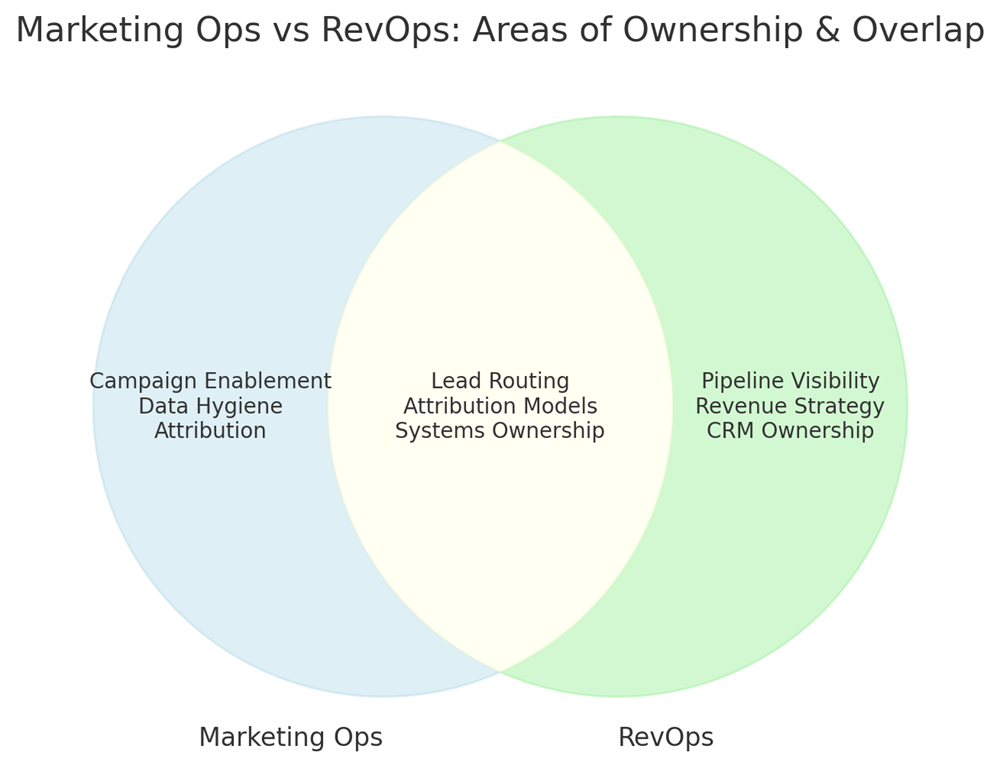
This Venn diagram clarifies distinct ownership areas and where collaboration is required—lead routing, attribution models, and systems ownership.
The Payoff of Clear Boundaries
When Marketing Ops and RevOps are aligned, organizations see:
• Cleaner campaign-to-revenue data
• Faster lead response times
• More accurate forecasts
• Less finger-pointing between teams
Instead of debating ownership, teams focus on what matters most: scaling the pipeline and closing deals.
✅ Takeaway: Marketing Ops drives campaigns. RevOps drives the revenue engine. Together, they’re two gears in the same machine—if they stay aligned, the whole GTM engine runs faster and smoother.
Leave a Reply