How Time Bandits Kill Revenue Operations
Revenue Operations is supposed to create leverage.
Instead, many RevOps teams drown in work that looks important but quietly sabotages outcomes.
This is Parkinson’s Law at scale.
“Work expands to fill the time available for its completion”.
In RevOps, work also expands to fill every meeting, dashboard, and “quick request” you allow.
The result isn’t just inefficiency — it’s strategic failure.
The RevOps Paradox: Always Busy, Rarely Transformational
Most struggling RevOps teams aren’t underperforming because of a lack of skill, tools, or intent.
They fail because:
- Every request feels urgent
- Every stakeholder wants “just one more thing.”
- Every analysis becomes a rabbit hole
- Every improvement turns into an ongoing project
RevOps becomes reactive through put rather than a proactive architecture.
This is where time bandits enter the system.
What Are Time Bandits in RevOps?
Time bandits are activities that:
- Consume disproportionate time
- Create the illusion of value
- Delay or displace higher-impact work
- Rarely tied directly to revenue outcomes
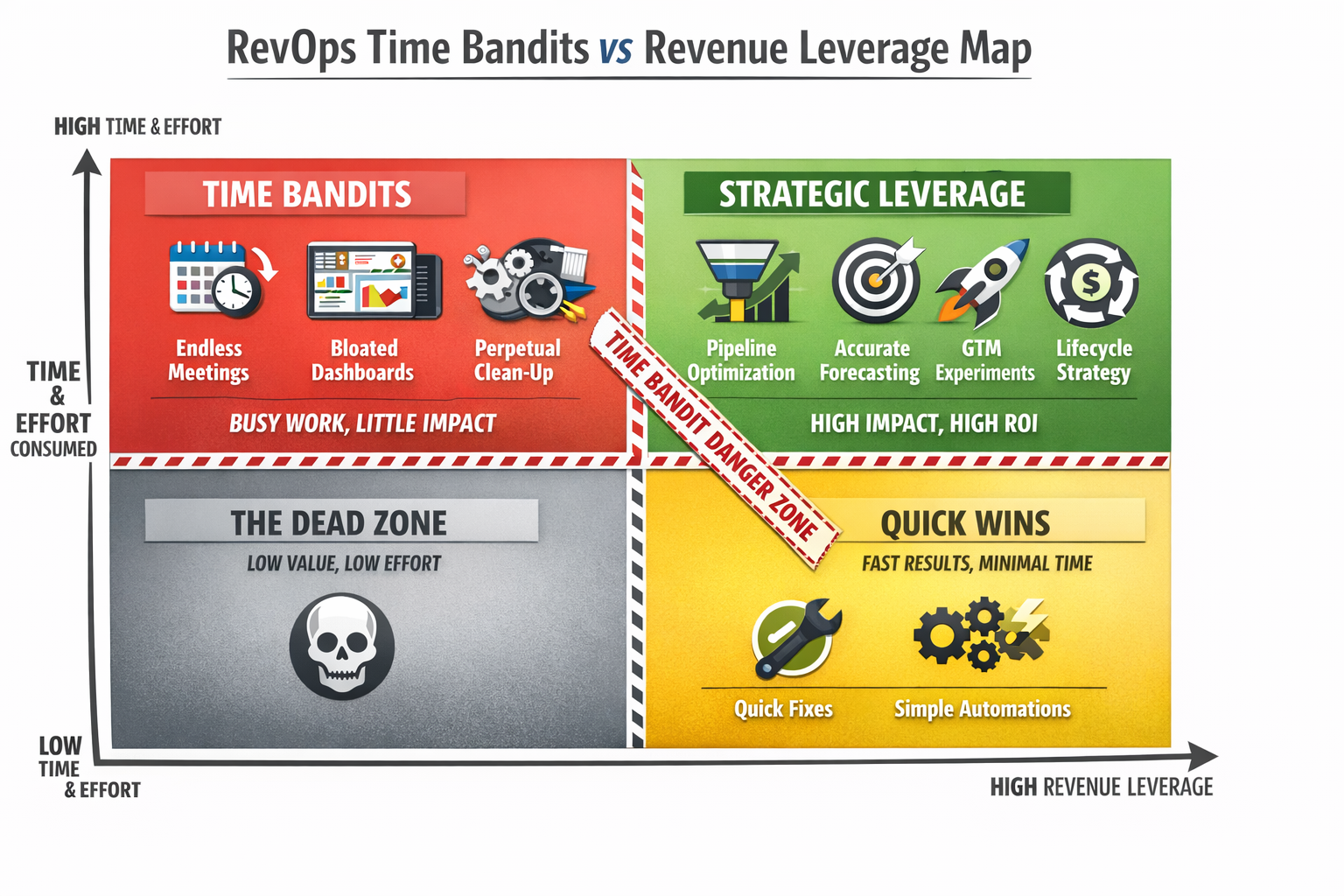
Common RevOps time bandits include:
-
Endless “Alignment” Meetings
Weekly syncs become biweekly deep dives, which become standing meetings with no decision authority.
Symptom:
- Same questions every week
- No owner, no deadline, no output
Cost:
- Strategic work never starts
- Decisions drift until urgency forces bad ones
-
Over-Engineered Dashboards
Dashboards expand because they can, not because they should.
Symptom:
- 40+ metrics, no primary KPI
- Stakeholders are asking for “one more cut.”
- Dashboards that explain everything but drive nothing
Cost:
- Analysis paralysis
- No single source of truth
- RevOps becomes a reporting team, not a growth engine
-
Perpetual “Clean-Up” Work
CRM hygiene, lead routing tweaks, lifecycle definitions — all important, none ever “done.”
Symptom:
- Same issues resurface every quarter
- No definition of “good enough.”
- Fixing symptoms instead of systems
Cost:
- Core architecture never matures
- Technical debt compounds silently
-
Custom Exceptions for Everyone
Every rep, region, or segment becomes “special.”
Symptom:
- Manual overrides
- One-off logic
- “We’ll fix it later” solutions
Cost:
- Process fragmentation
- Automation breaks
- Scaling becomes impossible
Parkinson’s Law Explains Why RevOps Fails Slowly
RevOps doesn’t usually fail loudly.
It gradually fails as time expands to absorb low-leverage work.
When deadlines are vague:
- Projects stretch
- Scope creeps
- Perfectionism replaces prioritization
- Stakeholders learn that RevOps time is elastic
Eventually, RevOps becomes:
The team that does everything, but owns nothing.
How Time Bandits Create Revenue Impact (Not Just Busyness)
This isn’t just a productivity problem. It’s a revenue risk.
Time bandits directly cause:
- ❌ Delayed pipeline fixes
- ❌ Missed forecast signals
- ❌ Slow GTM experimentation
- ❌ Inaccurate capacity planning
- ❌ Poor handoffs between Sales, Marketing, and CS
Every hour lost to low-impact work is an hour not spent improving funnel velocity, conversion, or retention.
Applying Parkinson’s Law to RevOps (Practically)
-
Time-Box RevOps Work by Revenue Impact
Instead of open-ended initiatives, define:
- Time limit
- Expected revenue lever
- Decision or output required
Example:
“Two weeks to define the lead scoring model that improves SQL conversion by X%.”
If it can’t tie to a lever, it doesn’t get time.
-
Define “Done” Aggressively
Most RevOps work expands because “done” is undefined.
Before starting, answer:
- Is this v1 or final?
- What decision will this enable?
- What won’t we optimize yet?
Good RevOps is iterative—not exhaustive.
-
Constrain Stakeholder Access to RevOps Time
Unlimited access creates unlimited work.
High-performing RevOps teams:
- Batch requests
- Require problem statements (not solutions)
- Prioritize based on GTM impact, not volume
Constraints protect the strategy.
-
Shift from Activity Metrics to Outcome Metrics
If RevOps is measured on:
- Tickets closed
- Dashboards built
- Meetings attended
Then the time bandits will win.
Instead, measure:
- Funnel velocity improvement
- Forecast accuracy
- CAC efficiency
- NRR expansion
What gets measured gets time.
The Real RevOps Maturity Shift: From Time to Attention
RevOps maturity isn’t about doing more.
It’s about deciding what deserves attention.
Parkinson’s Law teaches us that:
- Time expands unless constrained
- Attention follows structure
- Strategy dies without boundaries
The best RevOps teams don’t ask:
“Do we have time for this?”
They ask:
“Is this worthy of our time?”
Final Thought: Time Bandits Don’t Steal Hours — They Steal Outcomes
RevOps rarely fails because of bad intentions.
It fails because work expands until it crowds out impact.
If you want RevOps to succeed:
- Shrink timelines
- Narrow focus
- Kill low-leverage work fast
- Protect time for architecture, not just execution
Because in Revenue Operations, what you allow to consume time will eventually consume results.
Leave a Reply