 For nearly two decades, the CRM has been positioned as the “source of truth” for go-to-market teams. It was the hub for contacts, opportunities, activities, and reporting. But today’s revenue engines are more complex, more automated, and more data-dependent than traditional CRM was ever built to support.
The result: most organizations now operate with a bloated, fragmented GTM tech stack—one that increases cost, slows teams down, and ultimately limits revenue performance.
A new category has emerged to address this: the Revenue Operating System (Revenue OS). It’s not just a rebrand; it’s a fundamental shift in how companies think about data, workflows, automation, and the GTM brain that powers growth.
Here’s why the move from CRM to Revenue OS isn’t just inevitable—it’s already happening.
CRMs Were Built for Record-Keeping, Not Revenue Performance
Traditional CRMs (Salesforce, HubSpot, Dynamics, etc.) were designed to capture interactions and provide a structured repository of data. They’re excellent at tracking—but tracking is not the same as orchestrating revenue.
A modern GTM engine needs:
- Real-time data enrichment
- Cross-platform engagement signals
- Multi-object workflows that trigger actions across systems
- Forecasting logic driven by AI, not gut feel
- Unified analytics across marketing, sales, CS, and finance
CRMs were never built to provide these capabilities natively. So companies bolted on dozens of point solutions—such as intent data, enrichment, call intelligence, routing, scoring, task automation, product analytics, and more.
Leading to the next problem.
The GTM Tech Stack Has Become Too Complex to Manage
The average mid-market SaaS company now uses:
- 12+ tools to manage inbound and outbound pipeline generation
- 7+ tools just for sales engagement, enablement, and call intelligence
- 3–5 BI tools to supplement CRM reporting gaps
With every new workflow or revenue motion, teams add another tool.
Creating:
- Data silos that break dashboards and forecasting
- Inefficiencies due to overlapping functionality
- Higher cost and lower ROI on tech spend
- Operational friction because tools don’t talk to each other well
- Misalignment across Marketing, Sales, CS, and Finance
Revenue leaders today spend as much time managing integrations as they do managing people.
Something has to change.
The Rise of the Revenue OS: A Unified Brain for the GTM Engine
A Revenue OS rethinks the architecture from the ground up.
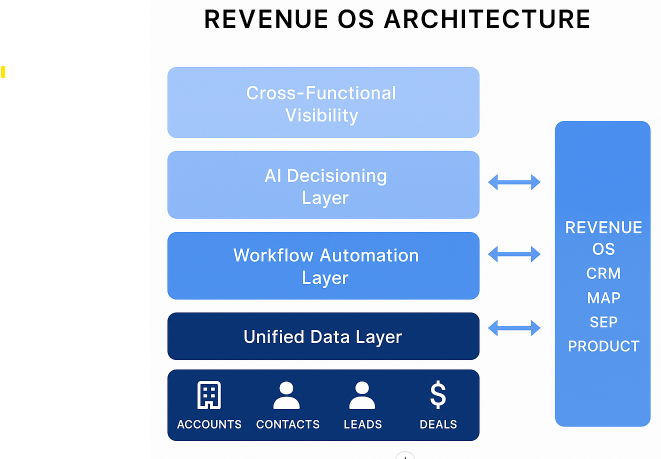
Instead of a CRM at the center with dozens of spokes, a Revenue OS is built as the central operating layer that orchestrates:
Data → Workflow → Insights → Action
Key attributes of a true Revenue OS:
✔ Unified Data Layer
A single, continuously enriched profile of every account, contact, lead, and deal—updated in real time across the stack.
✔ Workflow Automation Layer
Rules, triggers, and sequences that can touch any tool, including the CRM, MAP, SEP, and product.
✔ AI Decisioning Layer
AI models that score leads, predict pipeline risk, recommend actions, and surface insights.
✔ Cross-Functional Visibility
Shared dashboards and KPIs for Marketing, Sales, CS, RevOps, and Finance.
✔ Native Orchestration
Route leads, enrich accounts, trigger tasks, update fields, send messages, and flag risks—all without 10 different tools duct-taped together.
The Revenue OS becomes the GTM operating system, while the CRM becomes just one of many applications plugged into it.
Why Revenue OS Is Critical for the Next Era of GTM
I) AI Requires Clean, Connected, Actionable Data
AI doesn’t work well with messy, siloed data. A Revenue OS solves this by creating a clean, unified foundation for AI scoring, forecasting, and routing.
II) Ops Teams Need Control Without Bottlenecks
RevOps teams are tired of dependency chains: CRM admins, BI teams, MAP specialists, and vendor support.
A Revenue OS gives RevOps direct control of workflows, logic, and GTM automation.
III) CFOs Demand Efficiency and Tool Consolidation
A Revenue OS reduces spend by replacing multiple tools in enrichment, routing, scoring, operations, and analytics.
IV) CROs Demand Predictability
With clean data, automated workflows, and AI insights, forecasting moves from guesswork to accuracy.
V) CMOs and CSM Leaders Need Visibility Across the Full Journey
A Revenue OS creates a single view from:
- Lead → Opportunity → Customer → Expansion → Renewal
No more patching together answers from five systems.
What the Transition Looks Like (Phased Approach)
Organizations typically move through four stages:
Stage 1: CRM-Centric (Today’s Reality)
CRM + multiple point tools (routing, scoring, enrichment, SEP, analytics).
Stage 2: Ops-Centric Integration Layer
RevOps begins centralizing logic using iPaaS, automation tools, and custom scripts.
Stage 3: Revenue OS Adoption
Unified data + workflow orchestration replaces 5–15 tools.
Stage 4: Predictive, Automated GTM Engine
AI-enhanced forecasting, next-best actions, customer lifecycle orchestration, and automated pipeline generation.
If CRM is the address book, Revenue OS is the operating system that runs the entire revenue engine.
What This Means for RevOps Leaders
The role of RevOps is transforming from system admin to revenue architect.
RevOps teams will increasingly own:
- Data infrastructure
- Lifecycle orchestration
- AI scoring and insights
- GTM workflow automation
- Tool governance and ROI management
- Cross-functional KPI alignment
A Revenue OS consolidates and simplifies this work, allowing RevOps to focus on strategy rather than maintenance.
The CRM Isn’t Going Away — But It No Longer Runs the Show
CRMs still matter:
- They’re the system of record.
- They support pipeline tracking.
- They house activities and tasks.
But they are no longer the GTM command center.
The shift is already underway:
CRM = the database
Revenue OS = the brain
GTM teams need both—but they no longer need the CRM to be the center of gravity.
Final Thought: The Revenue OS Isn’t the Future—It’s the Present
Companies that modernize their GTM architecture now will benefit from:
- lower tech spend
- cleaner data
- more accurate forecasting
- faster revenue cycles
- aligned GTM teams
- repeatable, predictable growth
Those who cling to CRM-centric models will continue to battle slow processes, inconsistent insights, and a fractured stack.
The Revenue OS is the natural evolution of modern go-to-market operations—and RevOps leaders are the ones best positioned to drive that transformation.
Leave a Reply