For years, CAC:LTV has been treated as the north star of go-to-market efficiency. Boards ask for it. Investors benchmark it. RevOps teams report it.
And yet—
Many companies with “healthy” CAC:LTV ratios still miss forecasts, burn cash, stall growth, or collapse under the weight of operational drag.
The uncomfortable truth?
CAC:LTV tells you if revenue is theoretically profitable.
It does not tell you if your revenue engine is operationally efficient.
That gap is where growth strategies quietly fail.
It’s time to introduce a more complete lens:
The Revenue Efficiency Ratio (RER)
The Problem with CAC:LTV (And Why It’s Incomplete)
What CAC:LTV Gets Right
CAC:LTV answers a narrow but essential question:
“If we acquire a customer, do we eventually make money on them?”
It works well when:
- Sales cycles are short
- GTM motion is simple
- Growth is linear
- Operating complexity is low
That’s why it became dominant during:
- Early SaaS growth
- Product-led motions
- Low-touch SMB sales
What CAC:LTV Completely Ignores
CAC: LTV does not account for:
- Sales cycle length
- Pipeline velocity
- Forecast accuracy
- Operational overhead
- Internal friction
- Tool sprawl
- Headcount inefficiency
- RevOps drag
- Time-to-cash
Two companies can have the same CAC:LTV ratio and still have radically different outcomes.
One scales.
One stalls.
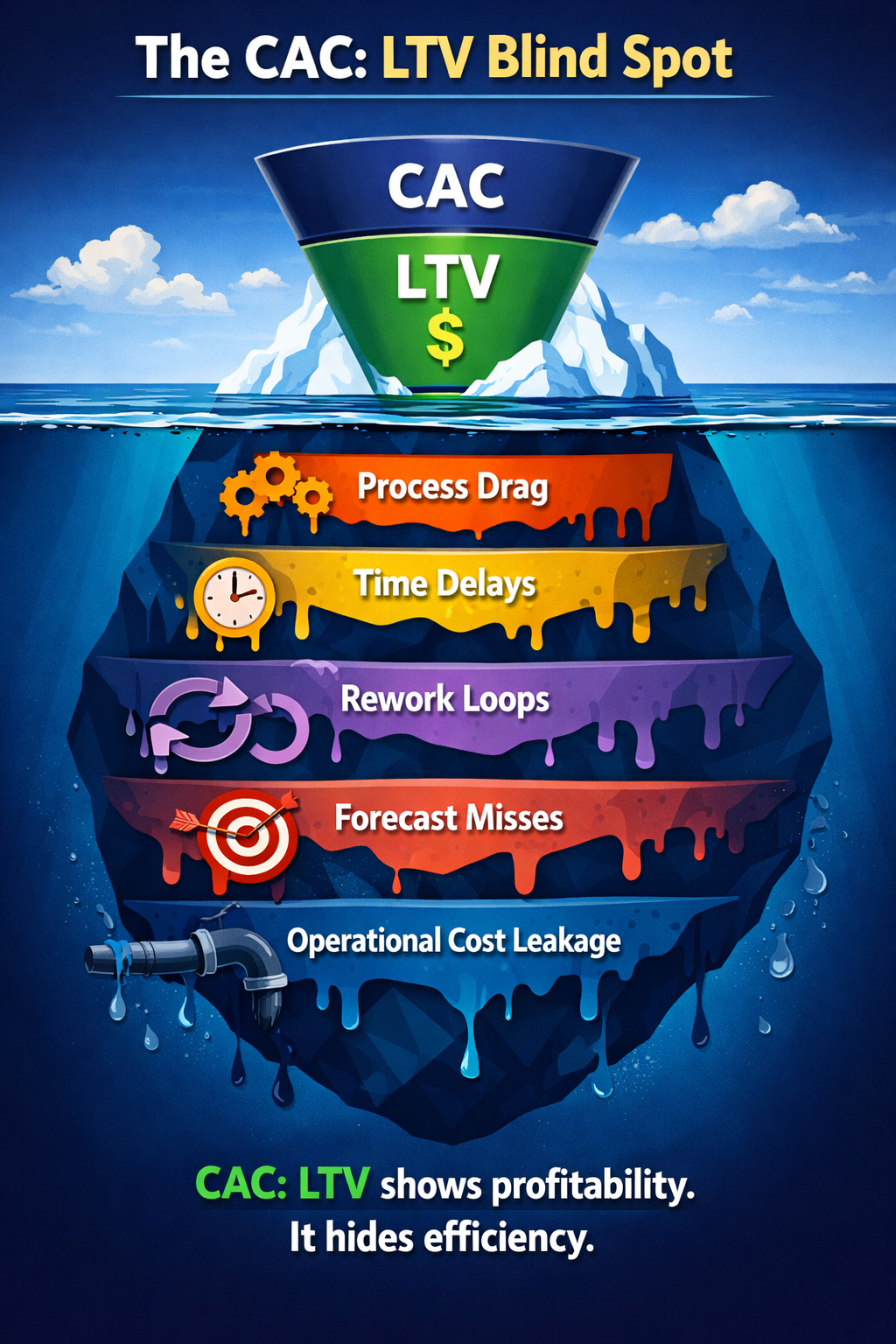
Why This Matters More Now Than Ever
Modern GTM environments are:
- Multi-product
- Multi-motion
- Tool-heavy
- Data-fragmented
- Forecast-sensitive
Revenue failure today rarely comes from bad unit economics.
It comes from:
- Slowness
- Friction
- Waste
- Misalignment
- False confidence
CAC:LTV can look great while:
- Deals take too long to close
- Sales capacity is underutilized
- CS is overloaded
- Revenue teams drown in admin work
- Growth flatlines
This is why RevOps leaders feel the pain before finance sees the numbers.
Introducing the Revenue Efficiency Ratio (RER)
The Core Idea
Revenue Efficiency Ratio (RER) answers a different question:
“How efficiently does our organization convert resources, time, and effort into realized revenue?”
It shifts the lens from profitability to performance efficiency.
The RER Formula (Conceptual)
There are many ways to operationalize RER, but the core structure looks like this:
Revenue Efficiency Ratio (RER)
RER = Revenue Output ÷ Revenue Input
Where:
Revenue Output includes:
- Net New ARR
- Expansion ARR
- Retained Revenue
- Cash Collected (optional lens)
Revenue Input includes:
- Fully loaded GTM headcount
- Sales cycle time
- Operational overhead
- Tooling cost
- Process complexity
- RevOps effort
- Forecast variance
RER is not a single KPI.
It’s a composite efficiency signal.
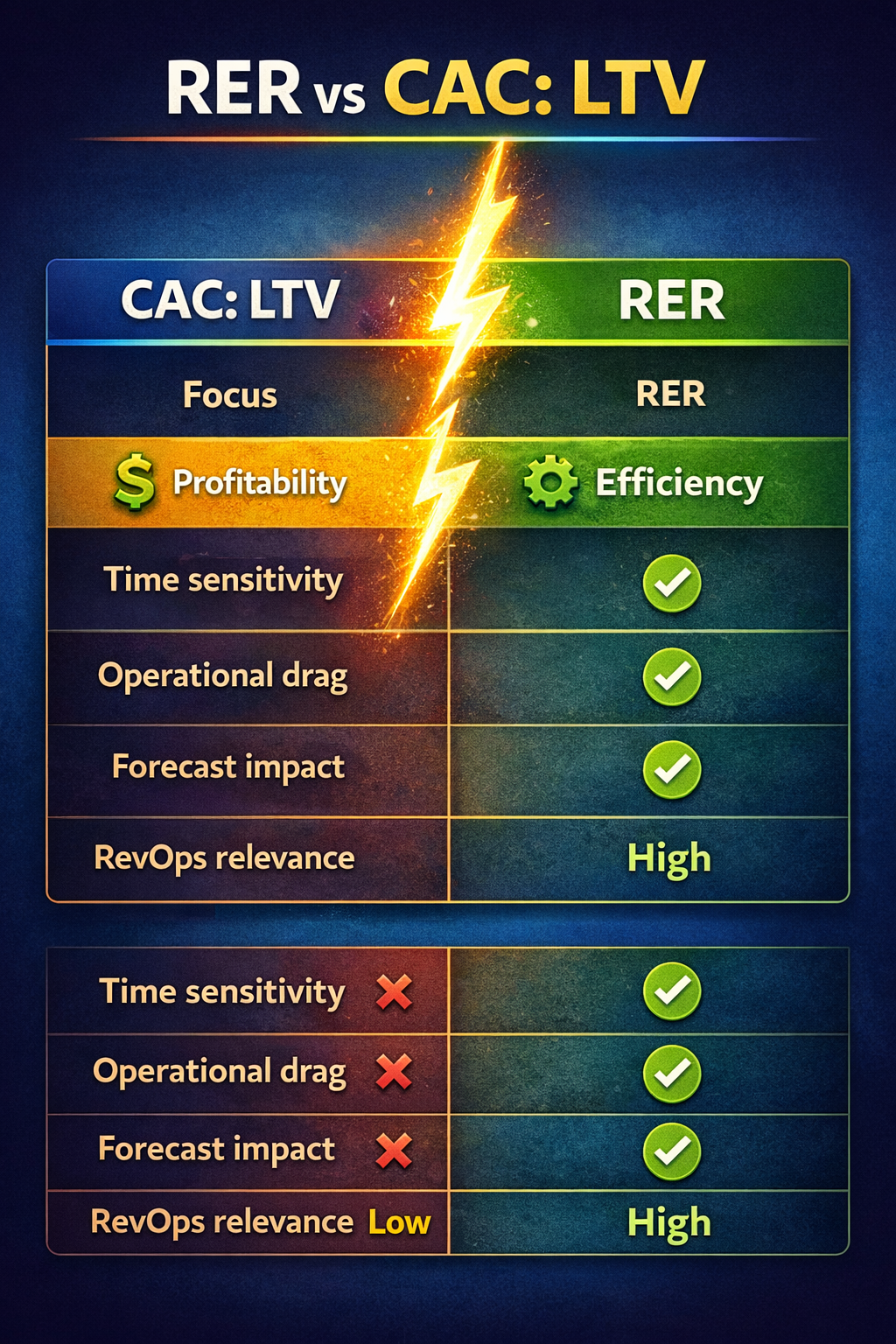
Why RER Changes the Conversation
CAC:LTV Says:
“We’ll make money eventually.”
RER Says:
“We’re converting effort into revenue efficiently, predictably, and repeatably.”
That difference matters when:
- Capital is constrained
- Hiring slows
- Forecast accuracy becomes existential
- Boards demand operational leverage
What RER Exposes That CAC:LTV Hides
- Time as a Cost
Two companies with identical CAC:LTV:
- One closes in 45 days
- One closes in 180 days
RER penalizes the second.
CAC:LTV ignores it.
- RevOps Drag
- Manual deal hygiene
- Broken handoffs
- Redundant tools
- Constant fire drills
These don’t show up in CAC:LTV.
They crush RER.
- Sales Capacity Waste
- Under-utilized reps
- Bloated management layers
- Low productive selling time
RER forces the question:
“How much of our spend actually touches revenue?”
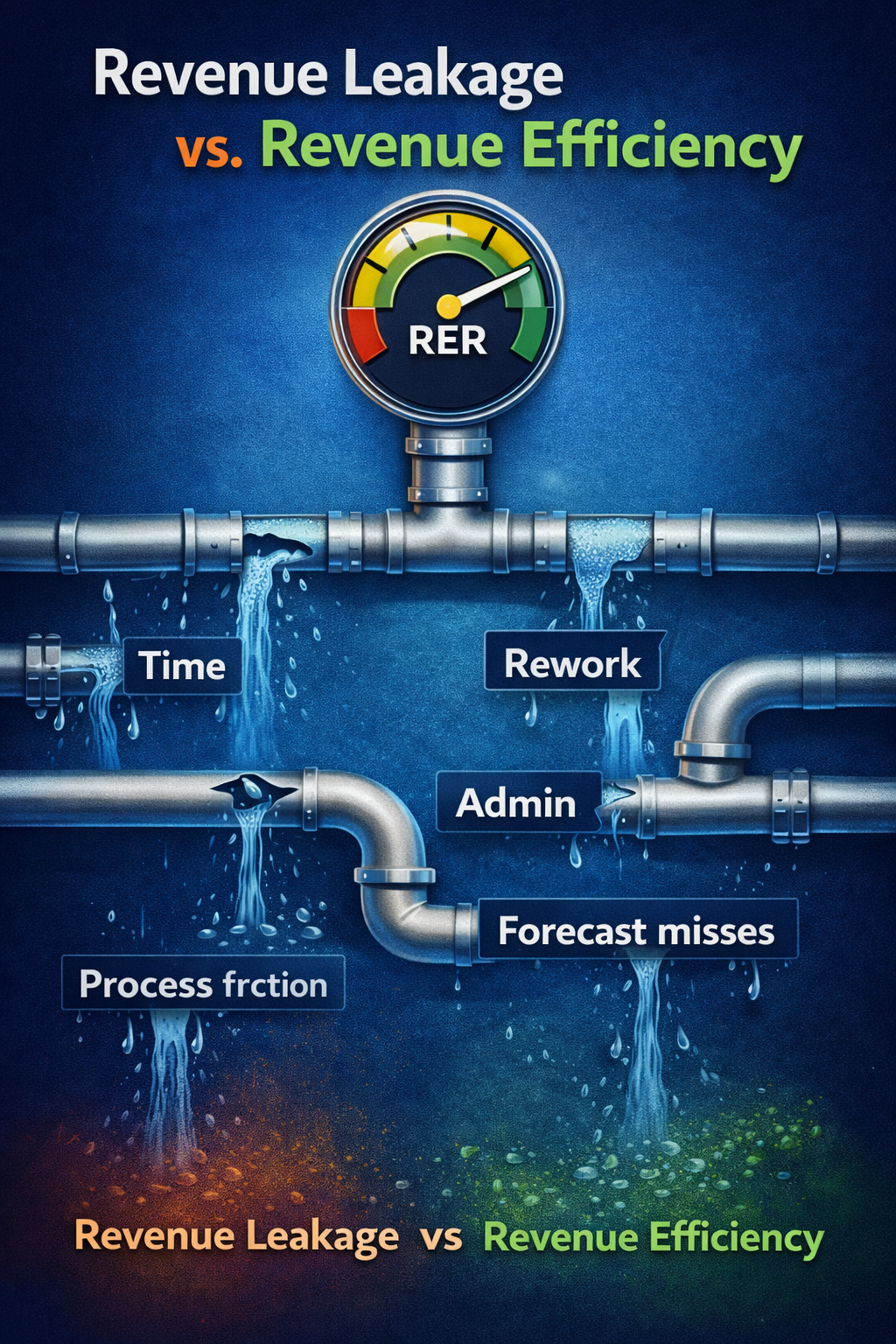
RER in Practice: A Simple Example
Company A
- CAC:LTV = 5:1
- Sales cycle = 60 days
- Forecast accuracy = 90%
- GTM tooling = streamlined
RER: High
Company B
- CAC:LTV = 5:1
- Sales cycle = 180 days
- Forecast accuracy = 60%
- Heavy RevOps intervention required
RER: Low
Same unit economics.
Completely different growth outcomes.
Why RevOps Owns RER
CAC:LTV lives mostly in:
- Finance
- Marketing analytics
- Board decks
RER lives in RevOps reality.
Because RevOps controls:
- Process design
- Tool architecture
- Data integrity
- Workflow automation
- Forecast mechanics
- Capacity modeling
RER becomes the RevOps scorecard for leverage.
How to Start Using RER (Without Overengineering)
You don’t need a perfect model on day one.
Start by tracking directional efficiency signals:
- Revenue per GTM headcount
- Revenue per sales hour
- Revenue per tool dollar
- ARR per forecasted dollar
- Cycle time trends
- Admin vs selling time ratio
RER is about trendlines, not perfection.
The Strategic Shift
CAC:LTV asks:
“Is this business viable?”
RER asks:
“Is this business scalable under real-world constraints?”
In today’s environment, that second question determines who survives.
Final Thought
If CAC:LTV was the metric of the growth-at-all-costs era,
The Revenue Efficiency Ratio is a metric of the era of operational discipline.
RevOps leaders who adopt it early won’t just report numbers; they’ll drive results.
They will change how revenue is built.